


The insulation layer of insulated pipes is mainly formed in two ways: factory prefabrication and on-site foaming. Prefabricated insulated pipes are formed in a factory by combining the working steel pipe, polyurethane insulation layer, and outer protective pipe. On-site foaming involves pouring polyurethane raw materials at joints or specific pipe sections after the pipe is installed, allowing it to foam and cure on-site. Both methods have their applicable scenarios, but their reliability differs significantly.
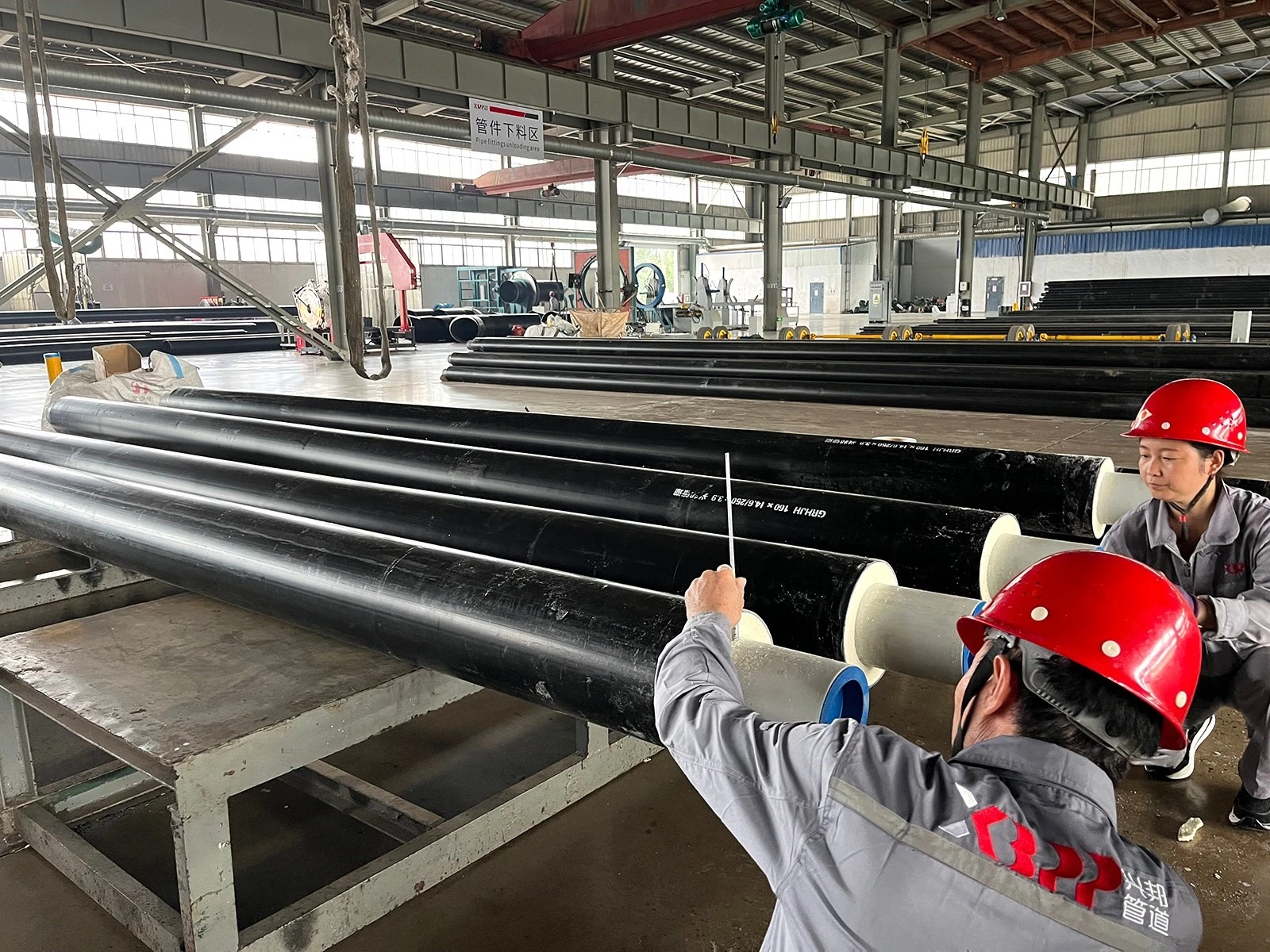
The core advantage of prefabricated insulated pipes lies in process control. The factory environment is stable, and foaming temperature, raw material ratio, and pouring pressure can be precisely controlled. Automated production lines ensure that the foam density, closed-cell rate, and thermal conductivity of each pipe are within standard ranges. Taking GB/T 29047 standard as an example, the foam density requirement for prefabricated insulated pipes is no less than 60 kg/m³, and the closed-cell rate is no less than 88%. These indicators can be guaranteed through continuous testing under factory conditions. The pipe-in-pipe process utilizes high-pressure foaming technology, injecting polyurethane raw material into the space between the steel pipe and the outer protective layer in a single step, ensuring a uniform and dense insulation layer. Before leaving the factory, it undergoes multiple tests, including density, thermal conductivity, and closed-cell rate; any that fail to meet the standards are rejected.
On-site foaming is a different story. Insulation repairs at the joints need to be completed in the pipe trench, and factors such as ambient temperature, air humidity, and substrate cleanliness all affect the foaming quality. Foam adhesion decreases below 15℃, and excessive humidity also negatively impacts the foaming effect. On-site manual foaming is limited by manual weighing and mixing, making it difficult to achieve the same uniformity of material distribution as machine foaming. Some data indicates that while cast-in-place polyurethane insulation performs well under experimental conditions, its effectiveness can drastically decrease in actual construction if quality control is inadequate. Furthermore, on-site foaming lacks systematic testing methods, and quality problems often only become apparent after operation.
So, which is more reliable? From the perspective of quality consistency, prefabricated insulated pipes have a clear advantage. Factory prefabrication transforms insulation production from "open-air work" to "indoor production," eliminating variables such as temperature, humidity, and the skill level of construction workers. The insulation quality of straight pipe sections is guaranteed, leaving only the joints and seams as weak points. In contrast, a fully on-site foaming solution requires on-site completion of the insulation layer for every section of the pipeline, exponentially increasing the difficulty of quality control. This is why centralized heating networks currently widely use prefabricated direct-buried insulated pipes, completing foaming only at joint seams-doing most of the insulation work in the factory and only handling the joints on-site, ensuring both the quality of straight pipe sections and the feasibility of construction.
The reliability of prefabricated insulated pipes stems from factory production conditions and a standardized quality control system. While on-site foaming offers flexibility, it is constrained by the on-site environment and human factors. For straight pipe sections, prefabrication is a more reliable choice; for joint seams, on-site foaming is currently the mainstream practice, but only if strictly followed according to specifications and using the same foaming material as the main pipe. The two are not mutually exclusive, but rather have distinct functions-prefabricated pipes ensure the minimum quality of straight pipe sections, while standardized on-site foaming safeguards the final checkpoint at joints.