


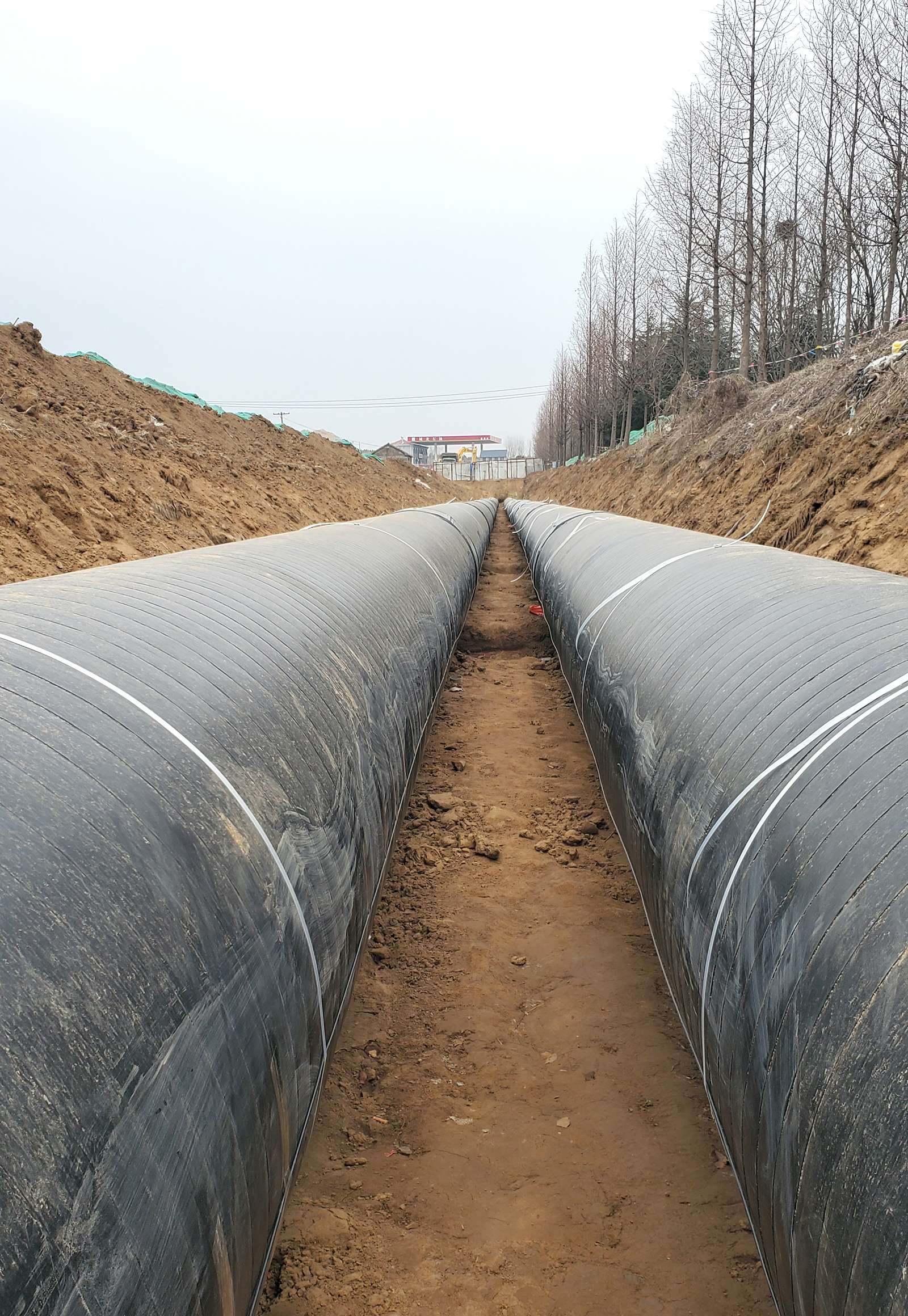
Once direct-buried insulated pipelines are underground, issues such as moisture ingress in the insulation layer, compromised joint seals, or pipeline leaks are difficult to detect promptly through manual inspections. Fiber-optic monitoring systems address this by making the pipeline's operational status visible rather than hidden. Distributed fiber-optic temperature sensing relies on the Raman scattering effect: a temperature-sensing fiber is laid along the pipeline, and a central unit transmits laser pulses into it. Since the intensity of the Raman scattering signal correlates with temperature, the system analyzes and demodulates these signals to determine the temperature distribution along the entire length of the fiber. If a leak occurs or water enters the insulation layer, the temperature profile at that location will show abnormal fluctuations, triggering an automatic alarm and pinpointing the location.
This technology is supported by a comprehensive standards framework. Standard T/CDHA 11-2022, *Technical Conditions for Fiber-Optic Monitoring Systems for Direct-Buried Heating Pipelines*, applies to systems based on temperature-sensing technology. The national standard GB/T 47547-2026 was released in April 2026 and is scheduled for implementation in November 2026. Additionally, in June 2025, ISO officially initiated the project for *Technical Requirements for Fiber-Optic Leak Monitoring Systems for Direct-Buried Heating Pipelines*. The progression from group standards to national standards and finally to an international standard project demonstrates that the technology has undergone rigorous technical validation.
Regarding costs, the primary investment occurs upfront-covering the temperature-sensing fiber-optic cable, the central monitoring unit, and the monitoring platform. Once buried alongside the pipeline, the sensing fiber requires virtually no maintenance; it is immune to electromagnetic interference and is suitable for long-distance deployment. A single investment covers the pipeline's entire lifecycle, resulting in low ongoing maintenance costs. Compared to traditional manual inspections, fiber-optic monitoring offers the advantages of long monitoring ranges and high localization accuracy. In contrast, electrical sensing systems require signal cables to be embedded within the pipeline and rely on resistance changes to detect leaks; they are susceptible to electromagnetic interference and offer relatively limited localization accuracy.
This technology is already being used in real-world projects. For instance, the intelligent pipeline network fiber-optic leak detection system-jointly developed by Tangshan Xingbang Pipeline and the Hefei Institutes of Physical Science, Chinese Academy of Sciences-utilizes a temperature-sensing fiber laid alongside the pipeline to pinpoint leak locations and provide real-time early warnings. Shiyan's heating pipeline network has also deployed a system comprising high-precision optical fibers, a distributed fiber-optic temperature sensing unit, and a backend monitoring platform. Whether installation is worthwhile depends on the pipeline's length, importance, and operational requirements. However, the trend indicates that this technology is shifting from an "optional extra" to a "standard feature"-standards are already in place, and the technology has matured, so it is now simply a question of when to install it.