


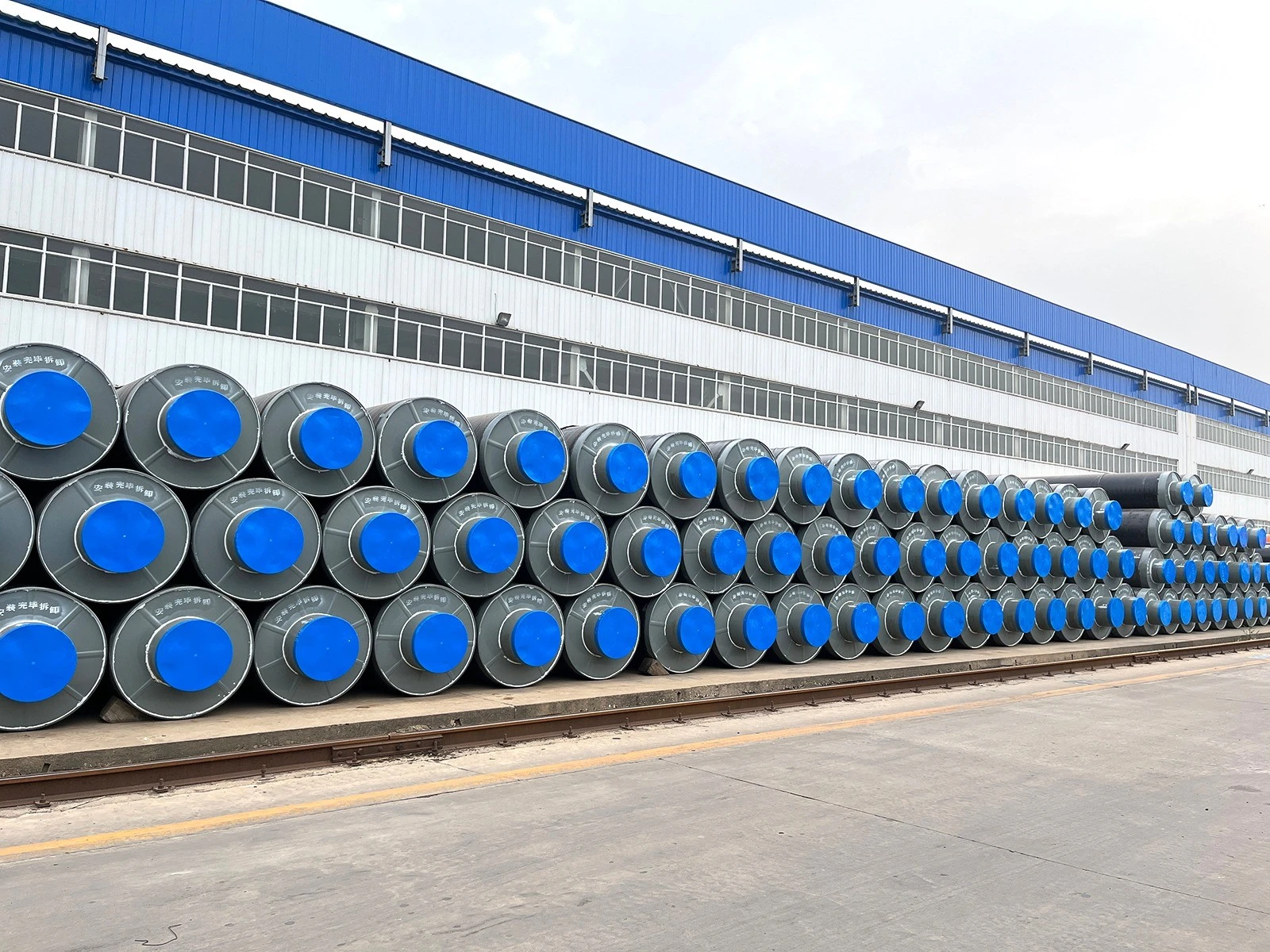
Standard polyurethane-insulated pipes are unsuitable for transporting steam at temperatures exceeding 200°C; instead, a "steel-in-steel" (steel-cased steel pipe) structure is required. These pre-insulated steam pipes consist of an inner carrier steel pipe, an insulation layer, and an outer protective steel pipe. They must comply with the standard CJ/T 246-2018, "Prefabricated Direct-Buried Steam-Insulated Pipes and Fittings for Urban Heating." Given their significantly more complex construction compared to standard polyurethane-insulated pipes, procurement and installation require careful attention to factors beyond just the insulation layer itself.
Steel-in-steel structures are categorized based on their sliding mechanism: "external sliding" and "internal sliding." In the external sliding design, the insulation material is wrapped around the carrier steel pipe; the carrier pipe, supported by steel brackets, slides along the inner surface of the outer protective pipe. An air gap-typically no wider than 15mm-is maintained between the insulation layer and the outer pipe, serving both as thermal insulation and as a channel for moisture venting. In the internal sliding design, the insulation material is integrated with the outer protective pipe, while the carrier steel pipe expands and slides within the insulation layer, with no air gap between the layers. The external sliding design offers superior moisture venting and allows for natural thermal expansion compensation through the use of pipe elbows. The internal sliding design, by contrast, is more compact and lighter in weight per unit length. The choice between these two structures depends on specific project requirements, including pipe diameter, operating temperature, and moisture venting needs.
The selection of insulation material is determined by the steam temperature. For pipelines operating below 250°C, glass wool is suitable. For temperatures between 250°C and approximately 320°C, a composite structure-combining glass wool with aluminum silicate needle-punched blankets-is recommended. For temperatures ranging from 320°C to 350°C, aluminum silicate needle-punched blankets or a similar composite structure may be used. Regardless of the material chosen, multi-layer insulation must be applied with staggered seams, and an outer aluminum foil reflective layer should be added to minimize heat loss. A moisture-venting pipe (vent stack) is a critical component of the steel-in-steel structure; it connects to the air gap at the bottom and extends above ground-typically to a height of about 0.5 meters-with a downward-facing elbow at the top to prevent rainwater ingress. Its function is to expel moisture-a process known as "moisture venting"-by gradually increasing the steam temperature during the pipe warm-up phase or in the event that the insulation layer becomes damp. This is a key advantage of glass wool insulation: even if water enters during construction, the material retains its structural integrity and thermal insulation performance once dried out via this venting process. Moisture-venting pipes typically have a diameter of 20 to 50 mm and are spaced approximately 30 to 50 meters apart. They should be positioned where pipe displacement is minimal-for instance, near fixed supports-to prevent thermal movement from damaging the insulation structure. The anti-corrosion treatment for the underground portion of these vent pipes must meet a standard at least as rigorous as that applied to the outer protective casing.
Since the outer steel casing is in direct contact with the soil, it requires an external anti-corrosion treatment, typically in the form of a 3PE (three-layer polyethylene) coating or a fusion-bonded epoxy (FBE) powder coating. Before the anti-corrosion layer is applied, the joints of the outer casing must undergo an airtightness test at a pressure of 0.2 MPa. Thermal insulation material must be installed between the guide supports and the inner (working) steel pipe to break thermal bridges and minimize heat transfer through the supports to the outer casing. The integrity of these components, much like that of the insulation layer itself, is critical to the overall service life of the steam pipeline. When procuring "steel-in-steel" (cased) steam-insulated piping, it is far more reliable to specify the medium temperature and the type of sliding support structure-and then verify the corresponding insulation materials, moisture-venting system, and anti-corrosion specifications-rather than relying on a vague, generic statement such as "complies with national standards."