


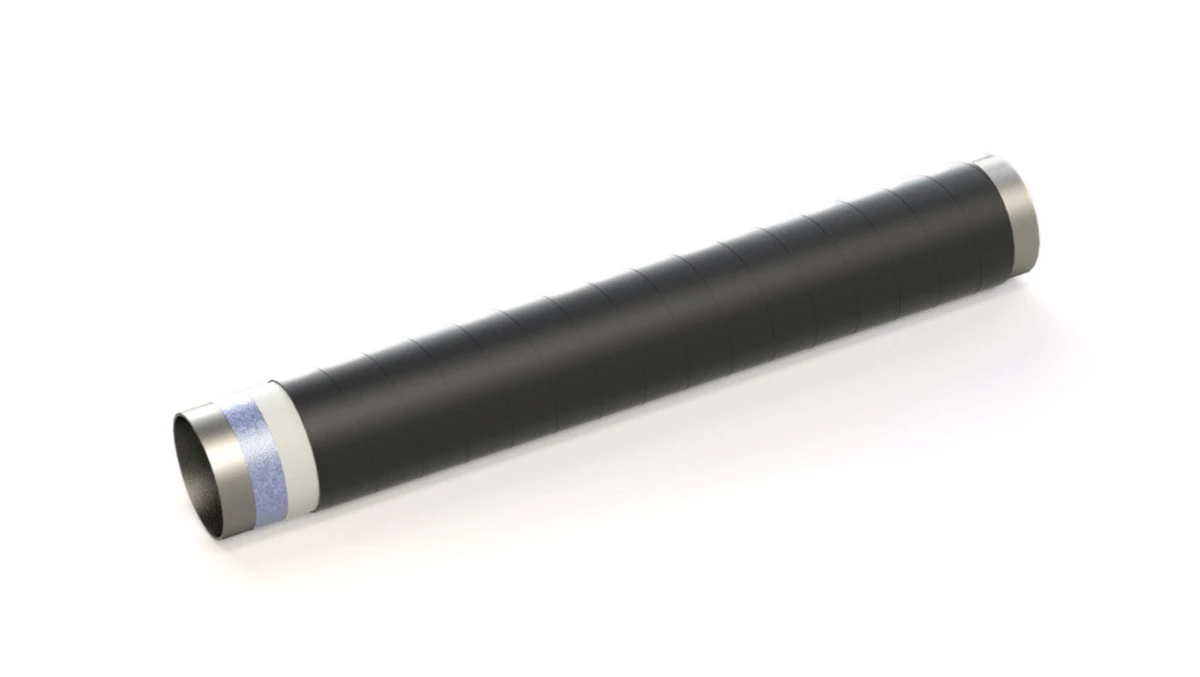
For steel pipelines transporting corrosive media or passing through corrosive soil, the external anti-corrosion coating is of vital importance. A 3PE (three-layer polyethylene) system-consisting of a fusion-bonded epoxy (FBE) primer, an adhesive intermediate layer, and a polyethylene top layer-is a commonly employed solution.
In one specific pipeline project, a high-temperature-resistant 2PE/3PE structure was utilized. The total thickness of the anti-corrosion coating was specified to be at least 2.0 mm, with the FBE layer measuring no less than 120 μm and the adhesive layer no less than 170 μm. At both ends of each coated pipe, an uncoated section of 110 mm to 120 mm was left, with the edge of the polyethylene layer beveled at an angle of no more than 30°.
Field joint coating is a crucial step in ensuring the integrity of the overall anti-corrosion system. Once the pipes are welded, the anti-corrosion coating at the weld joint must be reapplied. When using heat-shrinkable sleeves for this purpose, the accompanying epoxy primer must be mixed thoroughly on-site. It must be applied to a dry film thickness of at least 200 μm (some projects require 300 μm). The heat-shrinkable sleeve should only be installed after the primer has fully cured and passed inspection. The overlap between the heat-shrinkable sleeve and the existing polyethylene coating must be at least 100 mm. Before applying the joint coating, the area must be cleaned-removing burrs, weld spatter, and debris-and the surface must be blast-cleaned to an Sa 2.5 standard. Additionally, the polyethylene surface in the overlap area should be abraded to increase roughness.
Following the application of the field joint coating, a holiday detector (spark tester) is typically used to verify its integrity. The quality of these field joint coatings directly impacts the service life of the entire pipeline and represents a critical control point during the anti-corrosion construction process.
For pipelines requiring both anti-corrosion and thermal insulation, the sequencing of the anti-corrosion and insulation layers must be carefully coordinated. If the field joint coating is defective, even a perfectly applied insulation layer will fail to prevent the corrosion of the steel pipe.